
Our Technology
Inside the System That Grows America's Fish
Recirculating Aquaculture Systems represent the most advanced method of land-based fish farming. At Tech Farm, RAS is the foundation of everything we do — enabling year-round production, zero discharge, and a level of environmental control that open ponds and ocean cages simply cannot match.
Recirculating Aquaculture Systems, Explained
A Recirculating Aquaculture System (RAS) is a closed-loop fish farming system that continuously filters, treats, and reuses water — recirculating up to 99% of it rather than discharging it into the environment. Fish are raised in indoor or covered tanks where every environmental variable — temperature, dissolved oxygen, pH, ammonia — is monitored and controlled.
Unlike traditional pond farming or ocean net-pens, RAS does not depend on natural water bodies, weather patterns, or seasons. Production runs 365 days a year. Biosecurity is built in: because the water is treated before entering the tanks, the risk of disease transmission from wild fish, parasites, and environmental contaminants is virtually eliminated.
RAS technology was originally developed for salmon farming in Northern Europe and has been adapted globally for species including tilapia, shrimp, barramundi, and yellowtail. At Tech Farm, we use RAS specifically optimized for Nile tilapia — a species that thrives in the controlled, high-density environment these systems provide.
The Process
The Water Cycle Inside Our Tanks
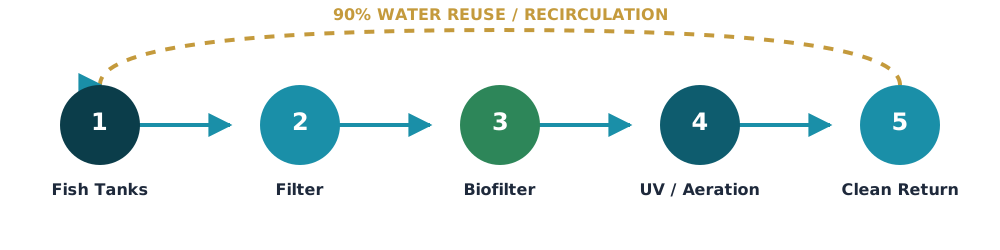
Every gallon of water in our system passes through a continuous treatment loop:
Fish Culture Tanks
Tilapia are raised in large tanks (40×40 ft, ~45,000 gallons each). Fish produce metabolic waste — primarily ammonia from respiration and organic solids from uneaten feed and feces. This waste-laden water flows continuously out of the tanks toward treatment.
Mechanical Filtration
Solid particles — fish feces, uneaten feed, organic debris — are physically removed from the water. This prevents solids buildup that would degrade water quality and clog downstream systems. The captured solids are collected for waste-to-value processing.
Biological Filtration
The most critical step. Beneficial bacteria convert toxic ammonia (excreted by fish) into nitrite, then into much less harmful nitrate. This nitrogen cycling process — called nitrification — is what makes recirculation possible. Without it, ammonia would accumulate to lethal levels within hours.
Water Treatment
Treated water passes through additional processes depending on system design: UV sterilization to eliminate pathogens, aeration or oxygenation to restore dissolved oxygen levels, and pH/alkalinity adjustment to maintain optimal conditions for both fish and beneficial bacteria.
Recirculation
Clean, oxygenated, pathogen-free water returns to the fish tanks. The cycle repeats continuously — 24 hours a day, 365 days a year. Only a small percentage of water is lost to evaporation and solids removal, making RAS one of the most water-efficient food production systems on Earth.
Fish Culture Tanks
Tilapia are raised in large tanks (40×40 ft, ~45,000 gallons each). Fish produce metabolic waste — primarily ammonia from respiration and organic solids from uneaten feed and feces. This waste-laden water flows continuously out of the tanks toward treatment.
Mechanical Filtration
Solid particles — fish feces, uneaten feed, organic debris — are physically removed from the water. This prevents solids buildup that would degrade water quality and clog downstream systems. The captured solids are collected for waste-to-value processing.
Biological Filtration
The most critical step. Beneficial bacteria convert toxic ammonia (excreted by fish) into nitrite, then into much less harmful nitrate. This nitrogen cycling process — called nitrification — is what makes recirculation possible. Without it, ammonia would accumulate to lethal levels within hours.
Water Treatment
Treated water passes through additional processes depending on system design: UV sterilization to eliminate pathogens, aeration or oxygenation to restore dissolved oxygen levels, and pH/alkalinity adjustment to maintain optimal conditions for both fish and beneficial bacteria.
Recirculation
Clean, oxygenated, pathogen-free water returns to the fish tanks. The cycle repeats continuously — 24 hours a day, 365 days a year. Only a small percentage of water is lost to evaporation and solids removal, making RAS one of the most water-efficient food production systems on Earth.
Why RAS Changes Everything
90% Water Efficiency
RAS reuses up to 99% of its water through continuous filtration and recirculation. Compared to traditional agriculture, our farms use approximately 90% less water per pound of protein produced. In a state like Florida — where water management is a perpetual concern — this efficiency matters.
Complete Biosecurity
Because water is treated before entering fish tanks, RAS eliminates exposure to wild pathogens, sea lice, parasites, and environmental contaminants including microplastics and heavy metals. Our fish are raised without antibiotics — the system makes them unnecessary.
Year-Round Production
No off-season. No weather delays. No storm shutdowns. RAS operates every day of the year in controlled conditions, producing consistent harvests on a predictable schedule. This reliability is what wholesale buyers and food service operators need from a supplier.
Zero Environmental Discharge
Our closed-loop systems release no wastewater into the surrounding environment. No nutrient runoff into waterways. No risk of farmed fish escaping into wild ecosystems. No effluent discharge permits needed. The environmental footprint stays inside the facility.
By the Numbers
0%
Water Reused
Closed-loop recirculation
0
Days / Year
Continuous production
0
Discharge
Zero wastewater released
0+
Active Tanks
Across 3 Florida farms
1.5 lbs
Market Weight
680g target per fish
0
Antibiotics
Clean water = healthy fish
How Our Approach Compares
RAS (Tech Farm)
Water use
90% less — recirculated
Production season
365 days/year
Biosecurity
Complete — closed system
Antibiotics
None required
Environmental discharge
Zero
Location flexibility
Anywhere — near markets
Freshness to consumer
Hours (local)
Traceability
Full — tank to table
Traditional / Import
Water use
High — open discharge
Production season
Seasonal, weather-dependent
Biosecurity
Exposed to wild pathogens
Antibiotics
Commonly used
Environmental discharge
Nutrient runoff, escapes
Location flexibility
Tied to water bodies
Freshness to consumer
Weeks (frozen, shipped)
Traceability
Limited once exported
What's Next
Building the Smartest Farm in America
Today, we monitor our tanks manually — testing water quality, adjusting feeding schedules, and tracking fish growth through hands-on observation and regular sampling. This works. We've scaled to 88+ tanks and three farms using these methods.
But manual monitoring has limits. A human can check a tank once or twice a day. A sensor checks it every second. A human can spot a pH trend over a week. A machine learning model can predict a pH spike four hours before it happens and recommend the exact corrective action.
We're investing in a two-tier AI system designed specifically for aquaculture operations at our scale:
Tier 1: IoT Sensors + Machine Learning
Real-time monitoring of dissolved oxygen, pH, temperature, ammonia, nitrite, and total suspended solids across every tank. Predictive models forecast water quality changes hours in advance. Computer vision cameras detect feeding behavior and estimate fish weight without handling. The goal: catch problems before they become problems, and optimize feeding to hit our 1.5-pound target as efficiently as possible.
Tier 2: AI Operations Manager
A large language model that sits on top of all sensor data and makes cross-domain decisions. It correlates water quality with feeding schedules with energy usage with growth rates — generating insights no single data stream could reveal. It produces daily briefings, harvest forecasts, and cost-per-kilogram tracking in plain language that any farm worker can act on.
This isn't theoretical. Research at institutions including Kentucky State University has demonstrated that ML algorithms can achieve 98% accuracy in predicting fish mortality from IoT sensor data in biofloc tilapia systems. The AI aquaculture market is projected to reach $1.4 billion by 2032. We intend to be early adopters — and to share what we learn with the rest of the industry.
See the Impact
Our technology enables our sustainability. See the environmental data, the circular economy vision, and what zero discharge really means in practice.